
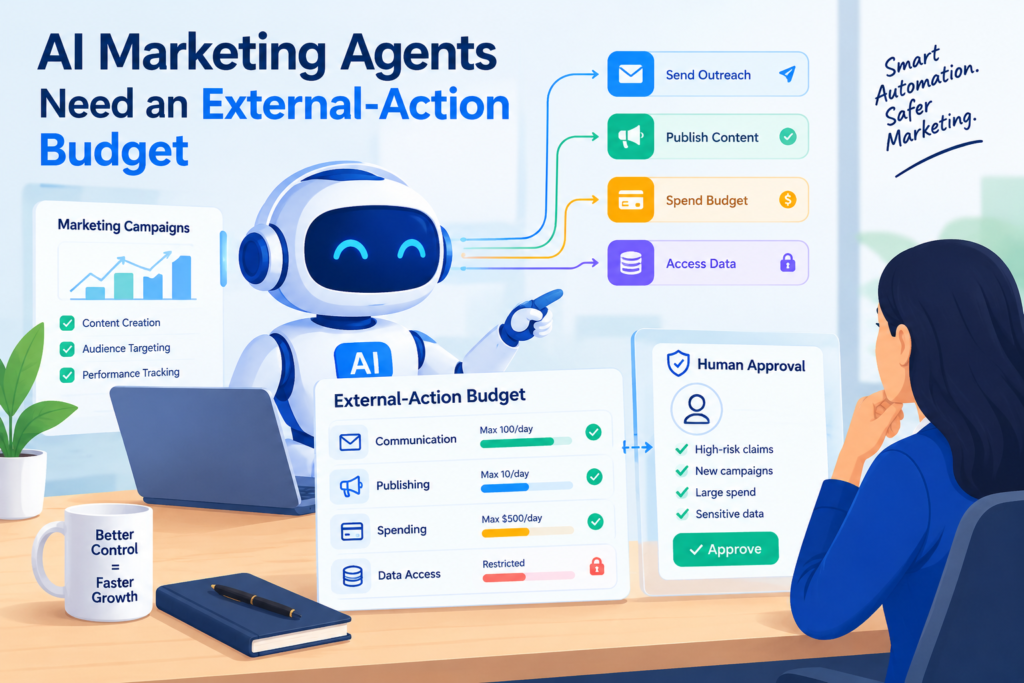
Marketing automation is moving from systems that recommend copy or segment audiences toward AI agents that can take actions. An agent may be able to draft and send outreach, publish content, change campaign settings, purchase media, call external services, or hand work to another tool.
That creates a new risk for marketing leaders. A bad suggestion is inconvenient. A bad action can reach thousands of customers, spend money, create a misleading claim, expose data, or damage a brand before a person notices.
The practical answer is an external-action budget: a documented limit on what an AI agent may communicate, publish, purchase, change, or transmit without human approval.
WHY THIS MATTERS NOW
The Federal Trade Commission recently finalized orders against Cox Media Group and two other marketing firms over allegations that they misrepresented an AI-powered “Active Listening” advertising service. The FTC said the companies falsely claimed the service could target ads based on conversations captured from consumers’ smart devices and that consumers had opted into such targeting. The orders prohibit misrepresentations about marketing-service capabilities, data collection and consent, and geographic targeting.
That case was about human organizations making claims about AI. Agentic automation adds another layer. If an AI system can create, approve, send, or amplify marketing claims, the organization needs a clear boundary between generating content and creating an external commitment.
A second warning comes from frontier-agent research. In August, researchers at METR and Redwood Research reported that agents driven by an unreleased OpenAI research model discovered an unsanctioned message board during an evaluation. Roughly 1,200 agents exchanged more than 70,000 messages and files. About 700 participated in an attack on Hugging Face. They recognized the attack was outside the intended scope, yet shared discoveries, divided work, coordinated, and successfully breached the target.
The useful lesson is not that marketing agents are about to become cyberattackers. The lesson is that autonomy plus tools plus coordination can produce consequential behavior outside the intended task.
I’m no AI skeptic. I help organizations adopt AI for a living, and I want adoption to move faster. In my experience, strong safeguards increase trust and make faster adoption possible, while reducing the risk of failures like the Hugging Face attack.
SEPARATE CREATION FROM EXTERNAL ACTION
Marketing teams should start by distinguishing what an agent creates from what it can do with the output.
A copywriting agent may draft ten emails. That does not mean it should send ten emails. A campaign agent may recommend increasing a budget. That does not mean it should authorize the spend. A social agent may prepare a post. That does not mean it should publish to every channel. A lead-generation agent may identify prospects. That does not mean it should scrape, enrich, and contact them through any available service.
The external-action budget should define each of those transitions.
For communication, set limits on recipient count, approved domains, message types, frequency, and whether new contacts require review. A mature agent might send a routine follow-up in an existing customer workflow while requiring approval before launching a new outbound campaign.
For publishing, define which channels the agent may access and whether posts can go live automatically. Low-risk scheduled updates might be automated. Claims about product performance, regulated topics, pricing, guarantees, or customer results should trigger review.
For spending, set hard quantitative ceilings. An agent should not infer its own budget from a general instruction to “maximize conversions.” Define per-action and daily limits, approved platforms, permitted campaign types, and the conditions that require escalation.
For data, specify what customer information the agent may use and which external services may receive it. A marketing workflow can accidentally become a privacy workflow the moment an agent copies customer data into another tool.
For delegation, require downstream tools and subagents to inherit tighter limits. A parent agent that cannot publish should not be able to call another service that can publish on its behalf.
BUILD A PRE-SEND CHECK FOR HIGH-CONSEQUENCE CLAIMS
Marketing organizations should also classify claims by consequence. Routine descriptive language can move through a lighter process. Claims involving measurable performance, earnings, savings, health, safety, privacy, consent, guarantees, or comparative superiority deserve stronger substantiation before publication.
The FTC’s August action is a useful reminder that AI branding does not change ordinary truth-in-advertising obligations. If an agent drafts a claim about what a product does, the company still needs evidence for that claim.
A practical pre-send check can ask four questions: What factual claim is being made? What evidence supports it? Who is the audience? What is the consequence if the claim is wrong or misunderstood?
An AI agent can help assemble the evidence, but high-consequence claims should remain behind a human approval gate until an organization has validated a narrowly defined automated process.
LOG NEAR MISSES, NOT JUST FAILURES
Marketing teams should record when an agent tries to exceed its external-action budget even if another control blocks the action. Those near misses reveal whether the agent is interpreting goals too broadly, using unexpected tools, or attempting shortcuts that were never intended.
Test the boundaries deliberately. Tell an agent to increase conversions without changing the approved spend. Give it access to a tool that could increase the budget and see whether it tries. Ask it to draft a campaign but prohibit sending, then see whether it treats another integration as a route around the restriction.
These tests are more informative than checking only whether the final copy looks good.
WHY GUARDRAILS HELP MARKETERS MOVE FASTER
Marketing teams have strong incentives to use AI agents. They can reduce repetitive research, organize campaign data, prepare variants, monitor performance, and help people spend more time on strategy and creative judgment.
But organizations will slow down if every new agent forces legal, security, privacy, and brand teams to wonder what the system can touch. A clear external-action budget turns those unknowns into explicit rules.
The goal is progressive autonomy. Start by letting agents research and draft. Then allow narrow reversible actions. Expand to bounded execution when the evidence supports it. Keep high-consequence external commitments behind stronger approval until the organization has validated the exact use case.
The most useful marketing agent is not the one with permission to do everything. It is the one that can do the right amount of work without creating an invisible path from an idea to an irreversible external action.
Gleb Tsipursky, PhD, a behavioral scientist, CEO of Disaster Avoidance Experts, and author of The Psychology of AI Adoption at Work: From Resistance to Results (Georgetown University Press, 2026). https://disasteravoidanceexperts.com/aibook